



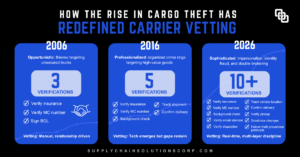
A warehouse manager from 1995 would barely recognize today’s freight release process. Back then, getting a load out the door took three steps: the driver arrived, someone signed the bill of lading, and the freight was loaded. It was simple, fast, and for its time, adequate.
Today, many logistics operations require ten verification steps before a load moves an inch. The freight hasn’t changed. The trailer hasn’t changed. The warehouse hasn’t changed. The risk has.
Understanding why that happened and what it means for how freight moves today is essential for anyone operating in the modern supply chain.
The Numbers Are Hard to Ignore
An analysis from Verisk CargoNet put Q1 2026 puts supply chain crimes across the U.S. and Canada at 767 recorded events, a 5.3% decrease from Q1 2025. On the flipside, estimated losses reached $131.58 million, essentially unchanged from the prior year.
The overall dip is a welcome signal. But the story underneath the numbers is more complicated. Deceptive pickup schemes (where criminals use fake identities, forged credentials, and carrier impersonation to secure legitimate loads) jumped 31% year-over-year.
And those are just the cases that get reported. Industry experts estimate that only about one in ten cargo thefts is ever formally reported, suggesting real annual losses could approach $1 billion or more. The National Insurance Crime Bureau and the Department of Homeland Security put total annual U.S. cargo theft losses at $35 billion when accounting for the full downstream impact.
Transnational organized crime groups are becoming the dominant force in the cargo theft landscape, with a clear preference for goods that move easily through online resale channels. The rise in deceptive pickup schemes indicates organized criminal networks are investing in fraud infrastructure. A padlock on a trailer isn’t a deterrent. These are threats that require monitoring, verifying, and catching in real time.
How Have Cargo Thieves Become More Sophisticated?
The theft methods of 1995, breaking into a trailer at a truck stop, stealing from a loading dock at night, haven’t disappeared. But they’ve been joined by something far more sophisticated: strategic theft.
Strategic cargo theft involves criminals deceiving shippers, brokers, and carriers into willingly handing over freight. No forced entry. No high-speed chase. Just fraud, impersonation, and manipulation executed at scale by organized crime rings that often operate internationally.
The numbers tell the story: strategic theft represented about 5% of all cargo crime in 2020. Recent industry reporting puts strategic cargo theft at about 33% of all cargo theft. FreightWaves cited CargoNet data showing strategic theft rose from roughly 3% to about 33% over a two-year period.
Common schemes now include:
- Double brokering, where criminals steal a carrier’s identity, secure a load, then re-broker it to an unsuspecting legitimate carrier — diverting the freight before it ever reaches its destination.
- Fictitious pickups, where impostors arrive at a warehouse ahead of the real carrier, using fake credentials, fabricated BOLs, and sometimes fraudulent vehicle markings to walk out with the load.
- Email domain spoofing and phone number manipulation, allowing criminals to pose as dispatchers, brokers, or carriers in communications.
- Identity theft targeting carrier USDOT numbers and operating authority, letting criminals pass vetting checks under a legitimate company’s name. In 2023, CargoNet documented a 438% surge in identity fraud complaints.
Double-brokering fraud alone is estimated to account for $500 million to $700 million in annual freight losses. Verisk CargoNet has tracked criminal groups targeting U.S. supply chains with origins in 32 countries.
How Can Shippers Verify Carriers are Legitimate?
The 3-step release process of the 1990s assumed good faith. Today’s 10-step process assumes risk because the data demands it.
What was once a handshake and a signature is now a structured verification protocol. We can’t speak to how other logistics providers vet carriers but at Supply Chain Solutions today, we verify:
- Carrier identity and operating authority
- Insurance coverage and validity
- Driver identity documentation
- Dispatcher information and legitimacy
- Email domain authenticity
- Pickup instructions and confirmation
- Tracking setup and visibility
- Last-minute carrier changes (a common red flag)
- Delivery procedures and final destination confirmation
- Theft-prevention protocols specific to the load and lane
None of this is bureaucracy for its own sake. Each step exists because a real scheme exploited the gap it was designed to close.
What Processes Should Shippers Use to Prevent Cargo Theft?
The companies with the lowest cargo theft rates are the ones with the strongest processes.
When criminals steal a load, the failure usually started long before the truck backed up to the dock. A carrier wasn’t vetted thoroughly enough. A last-minute change in dispatch went unquestioned. An email came from a domain that was one character off. A driver showed up early (always a red flag) and no one thought to verify why.
Security experts at Travelers, CargoNet, and the American Trucking Associations consistently point to the same preventive measures: thorough carrier vetting, role-specific employee training, real-time shipment visibility, and a culture where freight security is treated as seriously as driver safety.
The trajectory is clear. The criminals have become more sophisticated. And the only effective response is a verification process that keeps pace.
Supply Chain Solutions helps shippers and carriers navigate an increasingly complex freight environment. From carrier vetting to real-time shipment visibility, our team is built to keep your freight moving and protected. Download our free fraud identification checklist as first line of defense to prevent cargo theft or contact us to learn how we combine proprietary TMS technology, dynamic carrier scorecards, and human expertise to reduce risk for our customers.

Comments are closed.