




Most companies manage freight reactively: negotiate rates, book shipments, fix problems as they arise.
The companies winning are different. They improve continuously. They ask every month: where are we losing efficiency? Where are we overpaying? What can we change?
Continuous improvement isn’t a project. It’s a mindset.
Here’s what it looks like:
Analyze: Establish baseline metrics (cost per unit, on-time delivery, exception rates).
Design: Find the biggest opportunity (consolidation, underperforming carrier, premium-rate lanes).
Source: Identify, vet and secure the right carrier partners.
Execute: Test and measure impact.
Repeat: Every month. Always looking for the next 2-3% improvement.
Most companies do this once every few years. The best companies do it continuously.
Six Areas to Target for Improvement
Network Design: Are your supplier, carrier, and customer networks optimized? Most companies inherited theirs over time. Continuous improvement means regularly asking: “Would a redesigned network serve us better?”
Consolidation: Where are you shipping LTL when TL is possible? Where could suppliers coordinate? Most companies miss 30-40% of consolidation opportunity. Analyze monthly.
Carrier Performance: Track on-time delivery, cost performance, and exceptions by carrier. Then ask: which should we invest in? Which should we move away from?
Spend Visibility: Do you know which lanes are most expensive? Which carriers represent your largest spend? What percentage is fuel vs. base freight? When you understand your spend, you can optimize it.
Process Efficiency: How much of your freight management is manual (email quotes, spreadsheet comparisons, portal checking)? Continuous improvement means automating what you can.
Technology and Data: Are you making decisions with complete information? Or are you relying on partial data and anecdotal performance? Implement systems that provide real-time, complete visibility.
Why Continuous Improvement Matters
For a $5M freight spend, 2% annual improvement = $100K+ per year. Over five years, that’s $600K-$800K in savings through compounding.
Most companies optimize once every few years (5-8% savings), then stop. The companies winning improve 2-3% continuously. They adapt as markets change. They don’t get stuck.
How a 3PL Partner Enables Continuous Improvement
Most shippers lack the time, expertise, or visibility to improve alone. A strategic 3PL partnership bridges that gap.
A good 3PL:
- Brings expertise from optimizing hundreds of networks
- Provides visibility across your entire operation
- Benchmarks performance against industry standards
- Removes bias (they don’t have emotional attachment to current carriers)
- Implements change with infrastructure and carrier relationships
- Tracks and reports continuously on progress
The best partnerships are strategic. The 3PL becomes an extension of your team, obsessed with continuous improvement.
How Supply Chain Solutions Enables Continuous Improvement
Supply Chain Solutions enables continuous improvement through technology and expertise.
The Technology: SCS TMS
The Transportation Management System provides the visibility and data you need:
- Real-time tracking of all shipments and problems
- Integrated carrier quoting and performance data in one place
- Spend intelligence broken down by mode, carrier, and lane
- Customizable dashboards so each team sees what matters to them
- Automated alerts for problems before they escalate
The Expertise: Managed Transportation Specialist
Visibility without strategy is just data. Following our SCS proven process, our Managed Transportation Specialists:
- Audit your operation to find overpayments and consolidation opportunities
- Develop a strategic plan for network optimization, rate renegotiation, and process improvement
- Implement changes and manage the transition
- Report continuously on progress (cost per unit, on-time delivery, exceptions)
- Identify the next opportunity before you finish the current one
Together, TMS + MTS creates the foundation for continuous improvement.
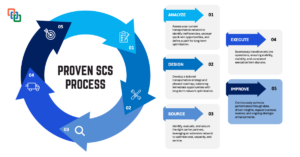
The Improvement Cycle
Month 1-2: Audit and identify top opportunity
Month 3-4: Implement improvement and track results
Month 5: Measure impact, identify next opportunity
Repeat: Build continuous improvement into your operation.
After 12 months: Better carrier relationships, optimized network, reduced manual work, and 2-3% continuous improvement.
The Bottom Line
Continuous improvement is a mindset. Companies winning on freight aren’t those who negotiated great rates once. They’re the ones improving 2-3% continuously. They’re obsessed with metrics. They’re strategic about carriers. They’re optimizing relentlessly.
Supply Chain Solutions helps you build that capability. TMS provides visibility and data. Your MTS provides expertise and strategy. Together, they make continuous improvement the way you operate.
If your freight operation is static, you’re falling behind. If it’s improving, you’re winning.
Ready to Start Improving?
Supply Chain Solutions offers a complimentary freight operation assessment. We’ll identify your top opportunities and show you what’s possible. Or use our self-assessment tool to identify strengths and weaknesses in your freight network.

Comments are closed.