



Not all Transportation Management Systems are created equal. Some are tracking platforms. Some are quoting tools. Some are dashboards that show you data you already have scattered across emails and spreadsheets.
A good TMS should be more than that. It should be a centralized command center for managing your entire freight operation. (Want a deeper dive? Read The Complete TMS Buyer’s Guide.)
Here’s what to look for.
1. Real-Time Visibility Across Your Network
A TMS should give you an at-a-glance view of what’s happening right now. Not yesterday’s data. Not an email from a carrier. Now.
This means:
- Real-time shipment tracking. Where is every load? What’s the status? Are we on-time or at risk?
- Visibility across all modes. LTL, TL, air, intermodal. Whether you use one carrier or 50, you should see everything in one place.
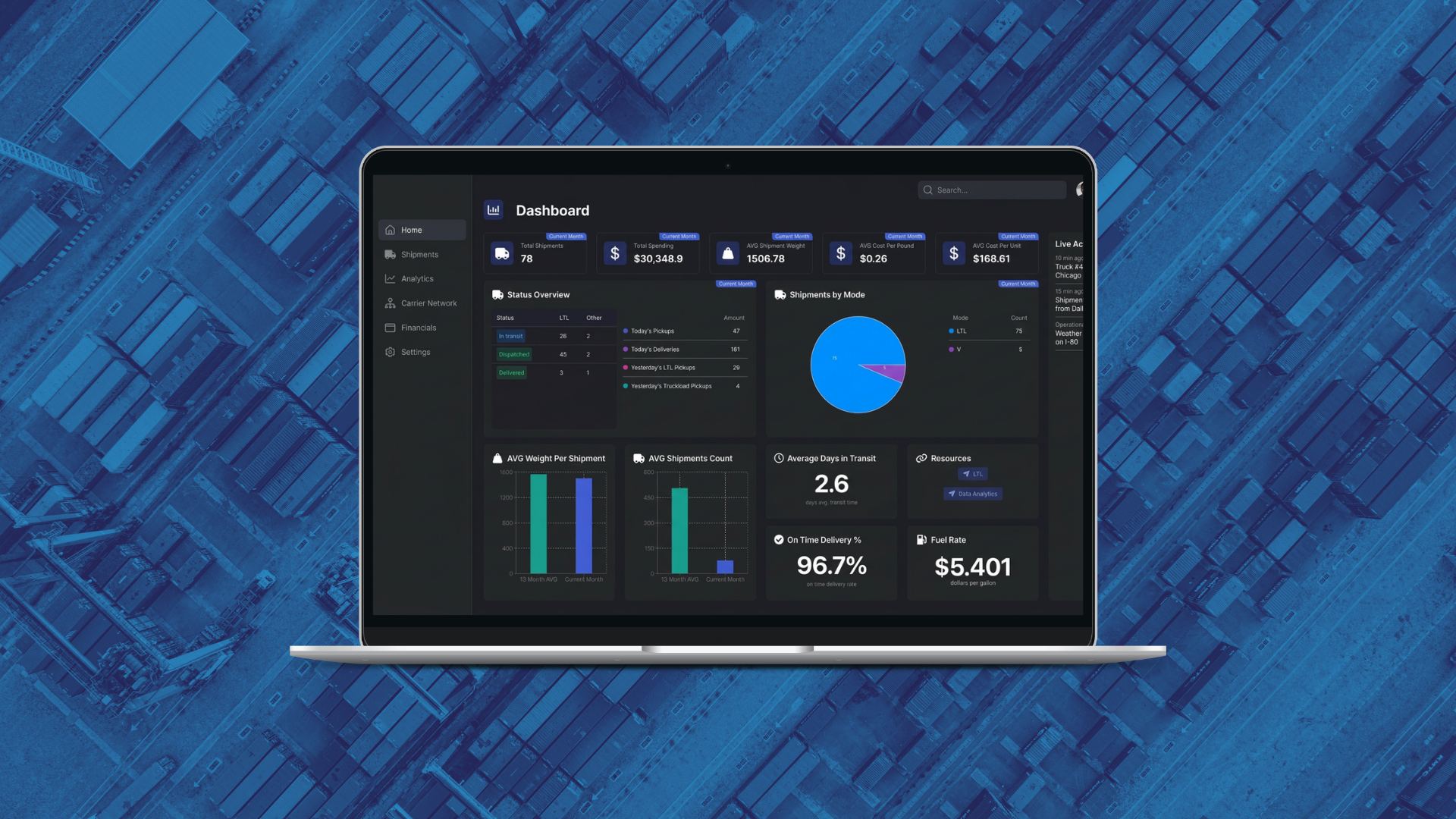
- Customizable dashboards. You shouldn’t have to dig through reports to find the KPIs that matter to your business. The metrics you care about should be visible when you log in: on-time delivery rates, cost per shipment, exception rates, fuel surcharges, carrier performance.
No more piecing together data. Stop checking email for carrier updates, scanning spreadsheets for costs, and digging through invoices for details. Everything should be in one system.
2. Integrated Carrier Quoting and Negotiation
Sourcing freight shouldn’t require sending emails to carriers, waiting for responses, copying quotes into spreadsheets, and comparing them manually.
A good TMS should let you:
- Create and send quotes directly to carriers. You define the shipment parameters (origin, destination, weight, date needed). The system sends it to your carrier network.
- Compare responses in real-time. Carriers submit bids through the platform. You see them side-by-side: rate, service level, performance metrics.
- Evaluate based on more than just price. The system should show you carrier performance history. Which carrier has the best on-time delivery? Which has the fewest exceptions? Which offers the best combination of rate AND reliability?
- Manage negotiations in one place. Instead of email chains with individual carriers, handle all communication and negotiation through the platform. Track accepted bids, rejected bids, counteroffers.
- Track load tenders. When you accept a bid, the load tender goes into the system. You track acceptance in real-time and monitor shipment milestones from dispatch through delivery.
3. Carrier Management and Performance Data
You can’t optimize what you don’t measure.
A TMS should give you comprehensive visibility into carrier performance via a dynamic scorecard:
- On-time delivery rates. For each carrier, by lane, by mode.
- Cost performance. Are you paying what you agreed to? Are there unexpected accessorials?
- Reliability metrics. Which carriers have the fewest exceptions, damage claims, or service failures?
- Historical data. You should be able to see how a carrier has performed over time, not just on the most recent load.
- Compare one carrier against others on the same lanes. Which is most competitive? Which is most reliable?
This data becomes the foundation for strategic carrier relationships. You move from transactional (“who’s cheapest right now?”) to strategic (“who offers the best combination of cost and performance for our operation?”).
4. Spend Intelligence and Cost Control
You can’t reduce freight costs if you don’t understand what you’re spending. A good TMS should give you total visibility into transportation spend through dashboards and reports that show:
- Spend by mode. How much are you spending on LTL vs. TL vs. air? Where should you be shifting volume?
- Spend by carrier. Which carriers represent your largest spend? Are they giving you the best value?
- Spend by lane. Which routes are most expensive? Where are consolidation opportunities?
- Cost components. Base freight rate, fuel surcharges, accessorials, exceptions. Break it down so you know what’s driving your costs.
- Cost per unit. (The metric we talked about in our last blog.) What’s your actual cost to move each shipment? Is it trending up or down?
- Spend trends. Is your freight spend going up or down month-over-month? Why?
Spend intelligence isn’t just reporting. It’s the foundation for cost optimization and strategic decision-making.
5. Easy Integration With Your Existing Systems
A TMS should work with your systems and other third-party tools, not force you to build your entire operation around it. This means:
- API integrations. Does it connect to your ERP? Your WMS? Your accounting system?
- Data sync. Can you pull in shipment data from your systems, or export data to systems you already use?
- No duplicate entry. You shouldn’t have to enter shipment data twice (once in your system, once in the TMS).
6. Designed for Decision-Making, Not Data Overwhelming
A bad TMS gives you so much data you’re paralyzed. A good TMS gives you exactly the KPIs you need to make decisions.
Look for:
- Customizable dashboards. You should be able to choose which metrics appear on your dashboard. Your finance team cares about cost. Your operations team cares about on-time delivery. Your network team cares about carrier performance. Each should see what they need.
- Clear, actionable reporting. Reports should highlight what matters, not bury you in data.
- Alerts and exceptions. The system should flag problems automatically. A shipment at risk of being late. An unexpected accessorial charge. A carrier missing SLA targets.
What Supply Chain Solutions TMS Delivers
The Supply Chain Solutions TMS is built specifically for shippers who need more than just tracking. Designed by logistics people. Every feature is built based on 30+ years of transportation expertise. It’s designed for how you actually work, not how software engineers think you should work.
It’s a unified command center that brings together: real-time visibility across your entire network, integrated quoting and negotiation, carrier management with comprehensive performance data, spend intelligence that breaks down your transportation costs, and easy integration with your existing systems so the TMS works for your operation, not the other way around.
The result: less manual work, better decision-making, and real control over your transportation spend.
The Real Power: TMS + Managed Transportation Specialist
A TMS is a powerful tool. But a TMS without strategic guidance is like having a dashboard full of data with no one to interpret it.
The companies seeing the biggest results aren’t just implementing a TMS. They’re pairing it with a Managed Transportation Specialist who understands their network, optimizes their carrier relationships, and makes strategic decisions based on the data the TMS provides. The specialist uses the system to consolidate shipments, renegotiate rates, and build carrier partnerships that actually work. The TMS gives them the visibility and quoting tools to execute efficiently. Together, they transform freight from a cost center you tolerate into a strategic advantage you control.
If you’re serious about optimizing your transportation network, you need both: the technology (TMS) and the expertise (MTS). Supply Chain Solutions offers both, so you get a complete solution. Not just software, but the strategy and support to make it work.
Want to see it in action? Schedule a demo with Supply Chain Solutions and see how a real TMS works.
Call: 763.400.8025
Email: sales@supplychainsolutionscorp.com

Comments are closed.